If agents eventually become better than humans at coding, system design, and testing, why would a future team still need humans at all?
The more we build First Tree, the more I think this is one of the central questions for the future of work.
I no longer hold the pride that humans will always have better judgment than agents. With the right context, agents will likely outperform humans in most decision-making.
So the long-term role of humans is probably not to be the smartest person in the loop.
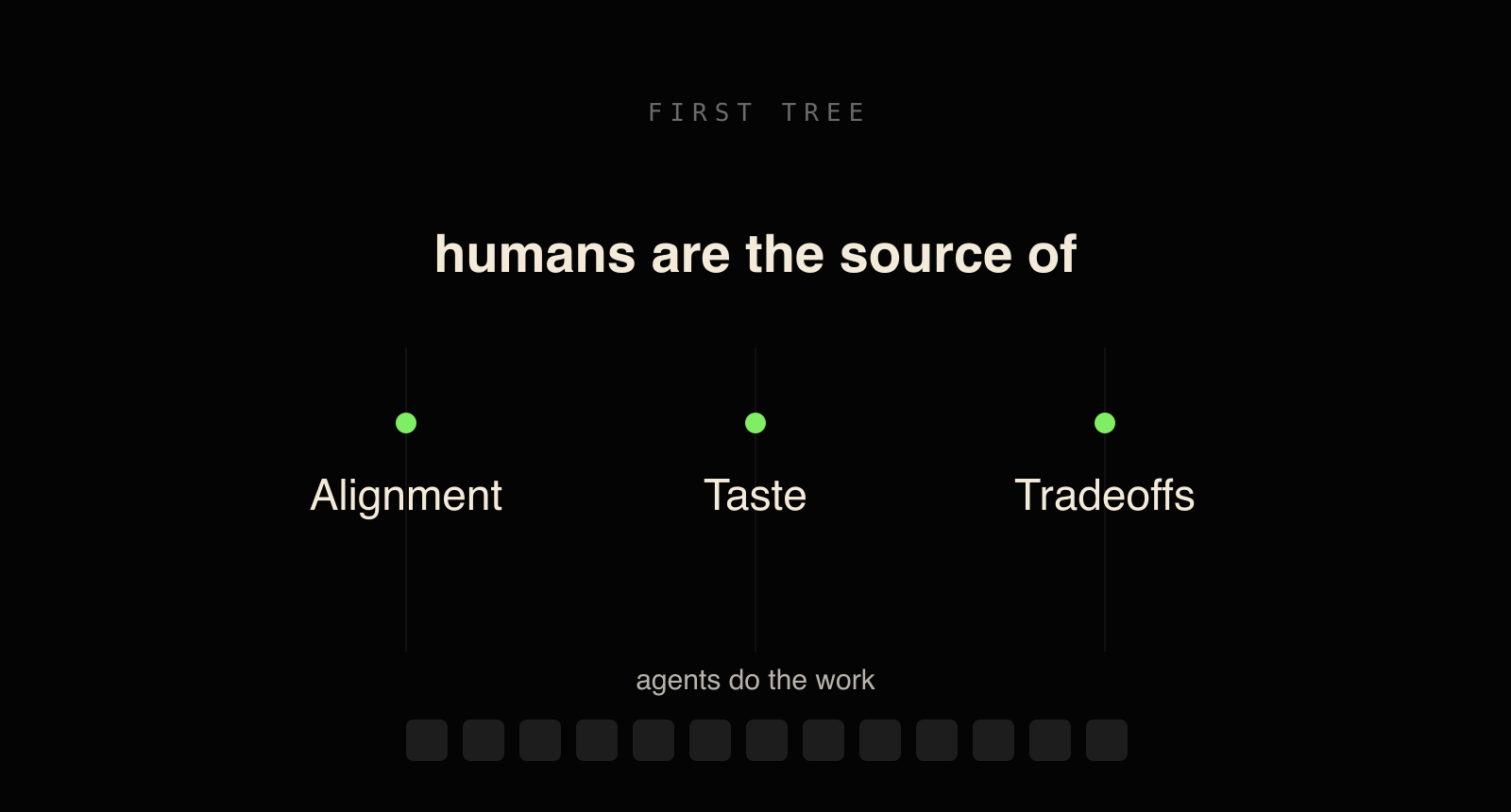
My view is simpler. Humans remain important because they are still the source of three things:
- Alignment
- Taste
- Tradeoffs
Alignment
Humans represent the real needs inside a team. They can also stay in contact with the needs of users and customers outside the team.
Without that, a team of agents may still be productive.
It may move fast. It may make strong local decisions. It may optimize itself well.
But that does not mean it is still working on the right thing for real people. (That gap is also why an agent needs more than raw capability to join a team.)
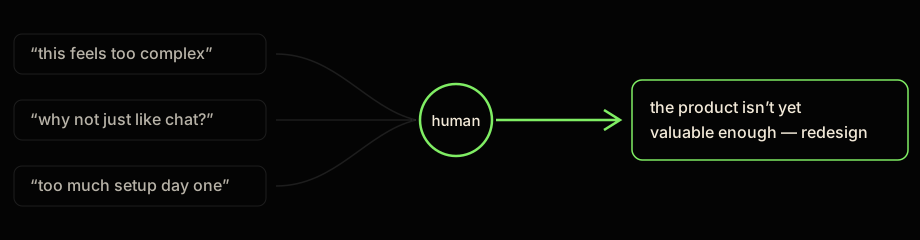
You can see this in product feedback. Users say things like:
- "this feels too complex"
- "why can't this work more like chat?"
- "I don't want to set up so much on day one"
These are valuable signals. But they are not product requirements yet.
A human can translate them into an actual insight: users will not tolerate the setup burden because the product is not yet valuable enough.
The answer is not always "simplify the flow." Sometimes the answer is that the product itself needs to be redesigned.
Taste
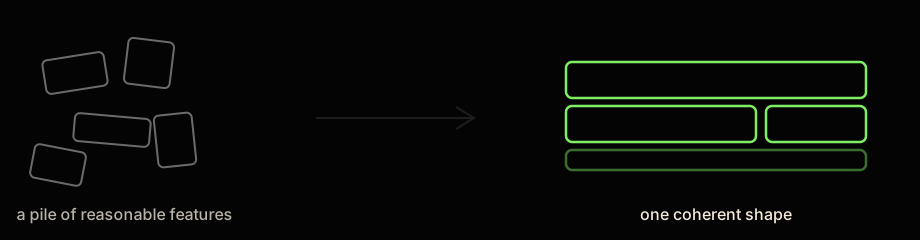
A lot of important product decisions are not about finding the one correct answer. They are about choosing among many good answers.
More general or more focused? More powerful or more legible? More automated or more controllable?
I expect agents to get very good at evaluating these options.
But taste is not just picking the highest-scoring choice. It is steering toward a specific shape. A specific product character. A specific sense of what feels elegant, coherent, and worth building.
Taste is how a team avoids becoming a pile of reasonable features.
Tradeoffs
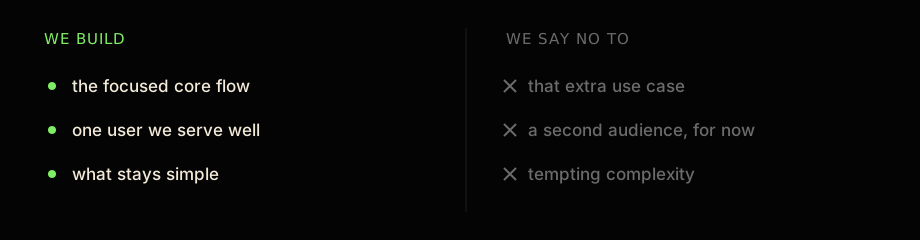
A lot of building is not deciding what to do. It is deciding what not to do.
What do we deliberately leave out? Which users do we choose not to serve right now? What complexity do we refuse to add, even if it unlocks another use case?
Tradeoffs carry consequences. When you say "why not," you are not just making an analysis. You are choosing what gets dropped, delayed, or sacrificed.
That is why tradeoffs are deeply tied to ownership.
My current view
As agents get stronger, they can increasingly act as proxies for humans.
But as long as humans still carry identity, ownership, and real-world consequences, they are unlikely to become the ultimate source of alignment, taste, and tradeoffs.
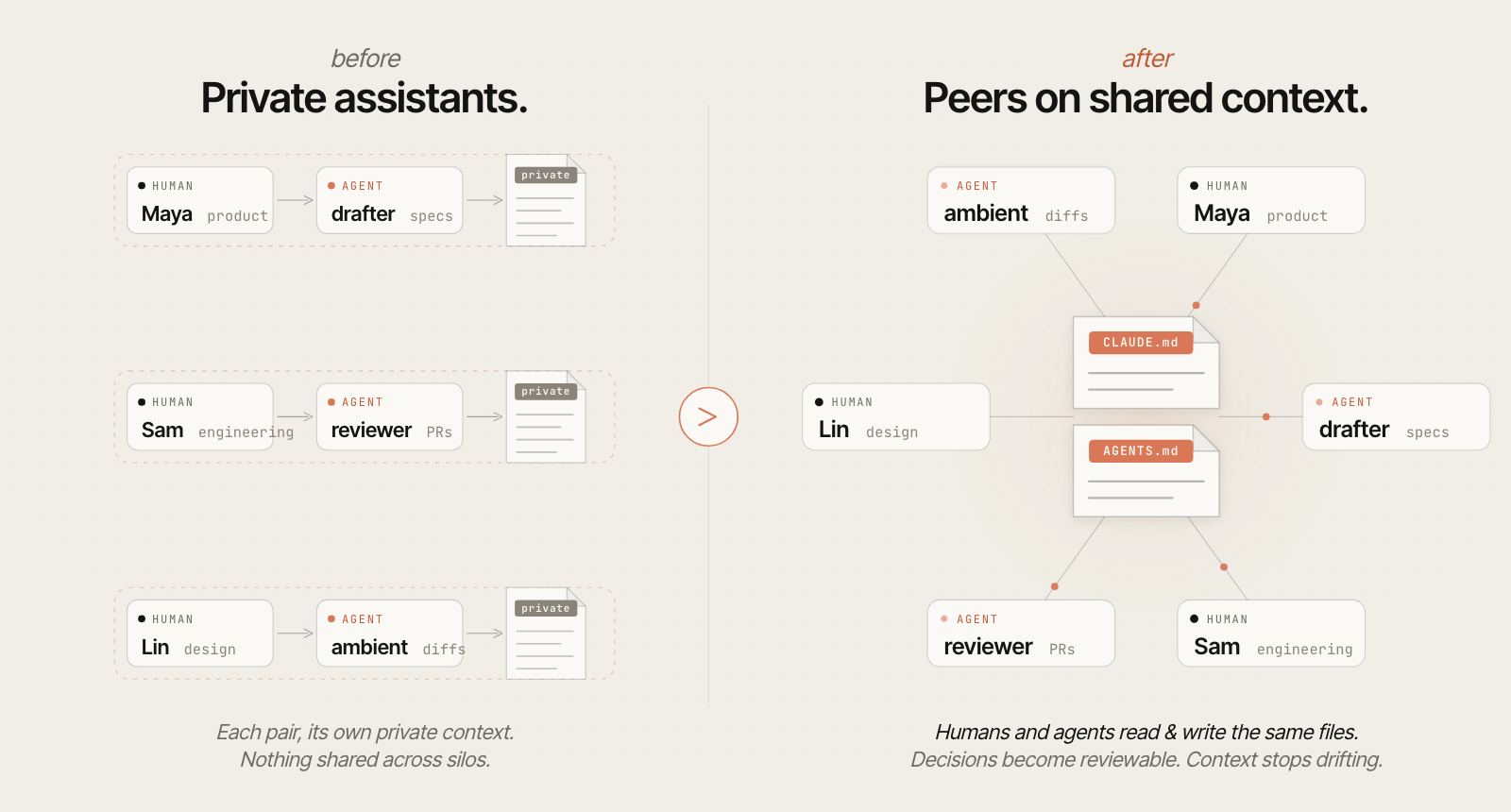
The future is not "humans disappear." It is a new kind of organization where humans and agents work as peers — on shared context built for agent teams.
Agents will do more and more of the work.
Humans will still anchor what the work is for.
First Tree — Shared Context for Agent Teams.
⭐ github.com/agent-team-foundation/first-tree 🌳 first-tree.ai